Floating Architecture Emerges as Climate Solution

The New Frontier of Resilient Design
As coastlines retreat and urban waterways face renewed attention, a remarkable architectural transformation is taking place across global waterfronts. Floating architecture, once considered experimental or temporary, has emerged as a serious solution for addressing 21st-century environmental and demographic challenges. This innovative approach to building on water represents more than technical achievement—it embodies a fundamental rethinking of humanity’s relationship with aquatic environments. From the flood-prone deltas of Southeast Asia to the crowded harbors of European cities, architects and urban planners are discovering that the future of sustainable development may literally float on our planet’s abundant water surfaces. This comprehensive examination explores how floating architecture is evolving from novelty to necessity, offering unique solutions for climate adaptation, urban density, and environmental harmony while creating breathtaking new possibilities for human habitation.
A. The Global Drivers Behind Aquatic Architecture
Multiple powerful forces are converging to make floating architecture increasingly relevant and urgently needed across diverse geographical contexts.
A. Climate Change and Sea Level Resilience
The most pressing driver remains our changing climate and its impact on coastal communities:
-
Sea Level Rise Adaptation: With oceans projected to rise 1-4 feet by 2100, floating structures offer permanent solutions for vulnerable coastal communities. Unlike fixed structures requiring constant elevation, floating buildings naturally adjust to changing water levels.
-
Flood Mitigation: In riverine and delta regions experiencing increased flooding, floating architecture eliminates flood damage while maintaining community continuity during extreme weather events.
-
Storm Resistance: Properly engineered floating structures can withstand hurricanes and typhoons better than fixed foundations through their ability to move with waves rather than resisting them.
B. Urban Density and Land Scarcity Solutions
Growing urban populations face severe land constraints that water surfaces can help alleviate:
-
Utilizing Underused Waterways: Cities with rivers, lakes, or harbors can expand onto these underutilized spaces without land reclamation’s environmental damage.
-
Temporary Urbanism: Floating structures enable temporary use of water spaces for cultural events, markets, or pop-up facilities that can be relocated as urban needs evolve.
-
Infrastructure Expansion: Cities are deploying floating facilities for water treatment, energy generation, and storage where land is unavailable or prohibitively expensive.
C. Environmental and Sustainability Benefits
Building on water offers unique ecological advantages that align with contemporary sustainability goals:
-
Reduced Site Impact: Floating structures minimize disturbance to aquatic ecosystems compared to traditional dredging and land reclamation.
-
Natural Temperature Regulation: Water’s thermal mass provides natural cooling, reducing energy demands for air conditioning in warm climates.
-
Integrated Aquaculture: Floating developments can incorporate shellfish farming or aquatic vegetation that improves water quality while providing local food sources.
B. Technological Foundations of Modern Floating Architecture
Contemporary floating structures rely on sophisticated engineering solutions that ensure stability, durability, and comfort.
A. Flotation and Foundation Systems
The fundamental technology supporting aquatic structures has evolved significantly:
-
Concrete Pontoon Foundations: Reinforced concrete floats provide durable, stable platforms for larger structures while resisting corrosion and biological degradation.
-
Polystyrene Composite Systems: Expanded polystyrene cores encapsulated in concrete or fiberglass offer excellent buoyancy with minimal maintenance requirements.
-
Steel Pontoon Configurations: Galvanized steel floats provide robust support for heavy structures while allowing precise engineering control over buoyancy and load distribution.
-
Amphibious Foundations: For areas with fluctuating water levels, guided piles allow structures to rise with floodwaters while maintaining positional stability.
B. Mooring and Connection Technologies
Keeping floating structures securely positioned requires specialized mooring approaches:
-
Dolphin Pile Systems: Vertical piles guide vertical movement while restricting horizontal drift, ideal for locations with significant tidal or flood-related level changes.
-
Anchor Mooring Arrays: For deeper waters, sophisticated anchor systems provide secure positioning while allowing necessary movement in response to waves and currents.
-
Flexible Utility Connections: Specially designed utility bridges accommodate movement while maintaining continuous power, water, and data connections to shore infrastructure.
-
Dynamic Positioning: Computer-controlled thruster systems enable precise station-keeping for very large floating structures without traditional mooring systems.
C. Materials and Construction Methods
The marine environment demands specialized materials and construction approaches:
-
Corrosion-Resistant Materials: Marine-grade aluminum, stainless steel, and specialized concrete mixes withstand constant water exposure.
-
Biofouling Prevention: Innovative coatings and cathodic protection systems minimize marine growth that can compromise structures and ecosystems.
-
Modular Construction: Most floating structures are built in modules on land then towed to site, improving quality control and reducing construction time on water.
-
Composite Material Innovation: Fiber-reinforced polymers and advanced composites offer strength-to-weight advantages while resisting marine environmental degradation.
C. Design Principles for Successful Floating Architecture
Creating successful aquatic environments requires addressing unique design considerations beyond conventional architecture.
A. Hydro-Responsive Design Philosophy
Floating architecture demands rethinking fundamental design assumptions:
-
Dynamic Orientation: Structures must be designed to function effectively regardless of slight rotational changes in position.
-
Wave-Responsive Planning: Spatial organization must account for motion, placing sensitive functions near the center of rotation where movement is minimized.
-
All-Aspect Façade Design: Unlike land-based structures with defined front and back, floating buildings often address multiple directions equally.
B. Environmental Integration Strategies
Successful floating architecture enhances rather than fights its aquatic setting:
-
Water-Based Ecosystem Services: Designs can incorporate constructed wetlands, oyster beds, or floating gardens that improve water quality while providing habitat.
-
Microclimate Creation: Strategic positioning can create sheltered waters for swimming, aquaculture, or small craft mooring.
-
Current and Tide Utilization: Positioning can harness natural flows for ventilation, water exchange, or even energy generation.
C. Human Experience Considerations
The psychological and experiential aspects of aquatic living require careful attention:
-
Motion Perception Management: Design elements that provide visual stability references help mitigate potential motion discomfort.
-
Acoustic Environment Control: Water transmits sound differently than land, requiring specialized acoustic design for privacy and comfort.
-
Aquatic Connectivity: Multiple connection points to shore and between floating elements ensure social integration while maintaining nautical character.
D. Innovative Applications Across Building Typologies
Floating architecture is demonstrating remarkable versatility across numerous building types and functions.
A. Residential Solutions
From single-family homes to multi-unit developments, aquatic residences are proliferating:
-
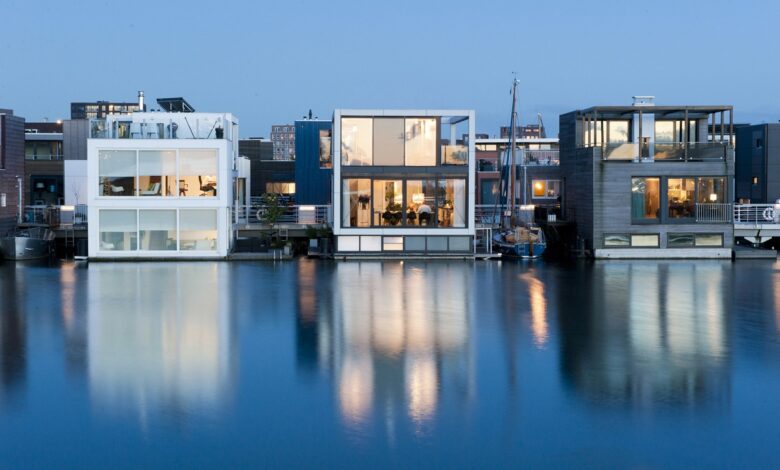
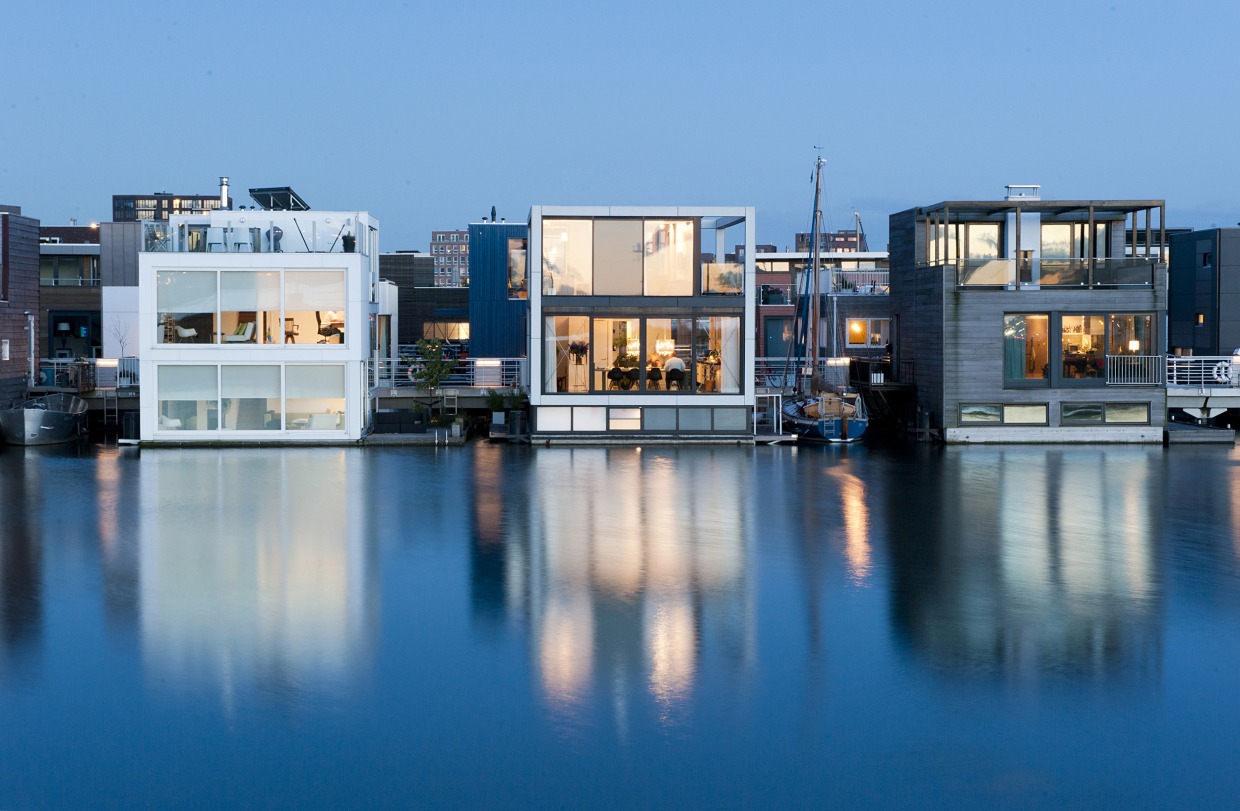
Floating Neighborhoods: Projects like Amsterdam’s IJburg demonstrate how entire communities can thrive on water with homes, parks, and commercial facilities.
-
Climate Refugee Housing: In flood-prone regions like Bangladesh, floating homes provide permanent solutions for populations displaced by climate impacts.
-
Luxury Water Villas: High-end resorts and private residences utilize floating technology to create exclusive environments with unparalleled water access.
B. Institutional and Public Buildings
Communities are locating important civic functions on water:
-
Floating Schools: In aquatic regions, schools on water ensure education continuity during floods while serving as community hubs.
-
Mobile Health Clinics: Floating medical facilities can reach isolated communities in archipelagos or flood-affected areas.
-
Cultural Facilities: Museums, performance spaces, and galleries on water create dramatic settings while maximizing urban space utilization.
C. Commercial and Infrastructure Applications
Practical commercial uses are driving technological innovation:
-
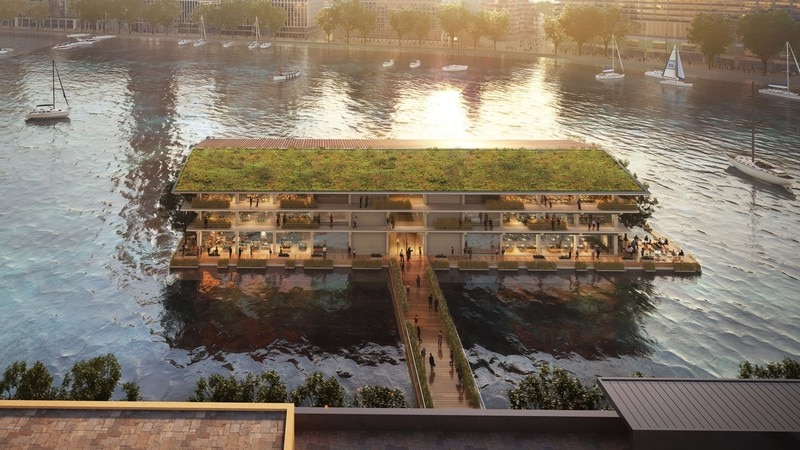
Floating Hotels and Restaurants: Hospitality ventures leverage the romance of water settings while avoiding scarce waterfront land costs.
-
Floating Renewable Energy: Solar arrays on reservoirs and ponds generate power while reducing evaporation and algae growth.
-
Floating Agriculture: Aquaponic systems on water bodies produce food while utilizing otherwise unproductive surfaces.
E. Case Studies: Pioneering Floating Architecture Projects
A. The Floating Seahorse, Dubai
This luxury residential project demonstrates how floating architecture can create exclusive lifestyles:
-
Three-Level Design: Underwater bedrooms, sea-level living areas, and upper decks create unique marine experiences
-
Coral Reef Integration: Each unit includes artificial reef structures that encourage marine life colonization
-
Private Marina Access: Each residence includes dedicated mooring space for watercraft
B. Makoko Floating School, Nigeria
This pioneering structure addressed urgent community needs with innovative design:
-
Local Material Utilization: Built primarily with locally sourced bamboo and wood
-
Community Construction: Built using local labor and techniques adapted for improved durability
-
Multi-Function Space: Served as school, community center, and gathering space for the aquatic community
C. Copenhagen’s Floating Student Housing
This project addresses urban density challenges with sustainable solutions:
-
Container-Based Construction: Repurposed shipping containers reduced costs and construction time
-
Integrated Green Technology: Solar panels, heat exchangers, and water recycling minimize environmental impact
-
Community Focus: Shared facilities and floating gardens foster social interaction among residents

F. Overcoming Implementation Challenges
Despite its potential, floating architecture faces significant barriers to widespread adoption.
A. Regulatory and Legal Frameworks
Most jurisdictions lack appropriate frameworks for aquatic development:
-
Unclear Ownership Rights: Legal status of water space usage remains ambiguous in many regions
-
Building Code Adaptation: Existing codes don’t address unique aspects of floating structures
-
Jurisdictional Complexity: Multiple agencies often claim authority over waterways, creating approval challenges
B. Economic and Financing Hurdles
Financial systems haven’t adapted to aquatic construction:
-
Insurance Challenges: Insurers struggle to assess risks for novel floating structures
-
Financing Obstacles: Lenders hesitate to finance assets that can theoretically be moved
-
Infrastructure Costs: Extending utilities to floating developments often requires significant investment
C. Technical and Maintenance Considerations
The marine environment presents unique operational challenges:
-
Durability Concerns: Long-term performance in harsh marine environments requires proven material systems
-
Maintenance Access: Servicing underwater components demands specialized equipment and expertise
-
Climate Extremes: Structures must withstand increasingly severe weather events
G. The Future Trajectory of Floating Architecture
The field is rapidly evolving toward more ambitious and integrated applications.
A. Scaling to Larger Floating Communities
The next decade will see expansion from individual structures to entire neighborhoods:
-
Floating Urban Extensions: Master-planned floating districts with comprehensive infrastructure
-
Multi-Use Floating Platforms: Large platforms supporting mixed-use development with residential, commercial, and recreational facilities
-
Mobile Urban Elements: Floating structures that can be reconfigured to meet changing urban needs
B. Technological Innovation Frontiers
Emerging technologies will expand possibilities for aquatic architecture:
-
Advanced Material Science: Self-healing concretes and bio-based composites will improve durability and sustainability
-
Energy-Independent Systems: Integrated renewable energy and closed-loop water systems will create fully autonomous floating developments
-
Digital Twin Technology: Virtual replicas will optimize management and maintenance of floating communities
C. Climate Adaptation Integration
Floating architecture will become integral to climate resilience planning:
-
Managed Retreat Implementation: Floating developments will enable orderly transition from vulnerable coastal areas
-
Disaster Response Infrastructure: Pre-positioned floating facilities will provide immediate support following climate disasters
-
Climate Migration Solutions: Purpose-built floating communities will house populations displaced by climate impacts
Conclusion: Embracing Our Aquatic Future
Floating architecture represents more than a technical solution to specific challenges—it embodies a fundamental reimagining of how humanity inhabits our planet. By viewing water not as a barrier but as opportunity, we unlock vast new territories for sustainable development while creating more resilient relationships with our changing environment. The growing interest in floating architecture reflects an emerging understanding that our future survival and prosperity may depend on embracing aquatic habitats with the same creativity and commitment we’ve applied to terrestrial development. As technology advances and climate urgency increases, floating communities will transition from novelty to necessity, offering beautiful, practical, and sustainable alternatives to conventional development. The architectural revolution happening at the water’s edge today may well determine how successfully we navigate the challenges of tomorrow’s changing world.
Tags: Floating Architecture, Aquatic Design, Climate Resilience, Waterfront Development, Sustainable Architecture, Flood Adaptation, Marine Construction, Floating Homes, Coastal Design, Blue Urbanism